You get the face right and the set still looks wrong. Same eyes, same nose, same jaw — and frame three is somehow a different woman. This is the most under-diagnosed problem in AI character work, because everyone checks the face and then stops. Recognition does not run on faces alone: it runs on age, build, marks, eye colour, hairstyle, visual language and emotional register, and any one of them can break a set on its own.
Why the face gets all the attention
Because human vision is built for it, and because it is the only attribute with an obvious failure mode. A warped face is instantly, viscerally wrong, so it dominates your attention while the other seven attributes drift quietly underneath.
There is a second reason: the face is the attribute a reference image pins most strongly. So the moment you start working reference-first, the face becomes your best-behaved attribute — and the remaining drift moves somewhere you are not looking.
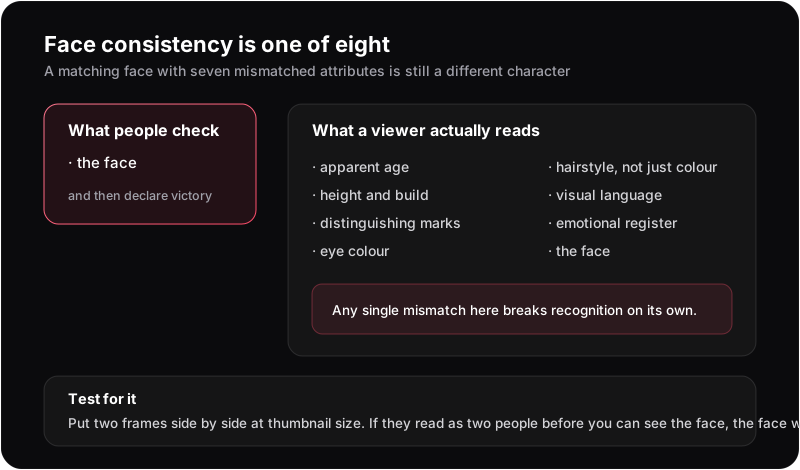 Face consistency is one item on a list of eight.
The seven other carriers of identity
Apparent age
The most disorienting when it moves, and almost never stated in a prompt. A five-year shift in apparent age reads as a sibling rather than the same person, and lighting alone can cause it: soft frontal light smooths a face younger, hard side light adds a decade.
Height and build
The attribute most likely to break, because two other things push on it constantly — the outfit, which implies a frame, and the pose, which implies proportion. Nobody writes "medium build, 170cm" in a prompt, so the model re-decides it every run from context.
Distinguishing marks
Scars, moles, freckles, tattoos, a chipped tooth. These are pure recognition signal and pure liability: they are small, so the model drops them easily, and viewers who noticed them once will notice them missing. If a mark is part of the character, it belongs in every prompt, not just the first.
Eye colour
Cheap to specify and easy to lose to a palette shift. Eyes pick up the dominant colour of an outfit or a light source more readily than any other feature, which is why a green-eyed character wearing amber tends to come back hazel.
Hairstyle, not hair colour
Colour usually survives because it is a word in your prompt. Length, parting, fringe shape and how the hair falls over the shoulders usually are not, and they change silhouette — which is the second thing a viewer reads after the face.
Visual language
Line weight, shading model, contrast, colour grade. Two frames of the same character in genuinely different visual languages are two illustrations of one character, not two frames of one story. This is the attribute people mistake for a "style setting" when it is actually part of whether the set holds together.
Emotional register
Underrated and very real. A character who reads as guarded in every frame and then beams at the camera reads as someone else, because we identify people partly by their default expression. Consistency of mood is part of consistency of character.
Evidence: one face, three attempted edits
To see which attributes are actually load-bearing, I took one anchored character and tried to move three identity attributes one at a time — same seed, same outfit wording, same backdrop, same pose. Only the free text changed.
The result was more interesting than the one I expected:
- The age edit was ignored. "A mature woman in her forties, subtle laugh lines" produced a face indistinguishable from the baseline. The anchor simply outvoted it.
- The hair and eye edit was ignored too. "Short blonde bob, bright green eyes, no hat" came back as the same long brown hair, the same red eyes and the same hat.
- The build edit landed. "Tall athletic build, broad shoulders, muscular arms" visibly changed the body — and dragged the outfit with it, swapping long sleeves for a sleeveless cut so the arms it had been asked for could be seen.
Two conclusions follow, and they point in opposite directions. First, the face is not where your risk is — it was the most stable thing in the run, exactly as reference-first workflows promise. Second, a strong anchor is also a constraint: identity-level attributes are held so firmly that free-text adjectives cannot move them. If you genuinely want an older version of a character, or a different eye colour, you need a different reference, not more words. Consistency tooling that holds identity against your accidental edits also holds it against your deliberate ones.
And note which attribute did get through. Build was the one that slipped, which is the same attribute this article predicts will slip — it is the one nobody pins and everything pushes on.
The identity checklist
Run this before you publish a set, not after. It takes a minute and catches the failures that a face-only check misses.
| Attribute | What to look for | Common cause when it slips |
|---|---|---|
| Apparent age | Same apparent decade across frames | Lighting change; softer or harsher key light |
| Height and build | Same shoulder width and proportion | New outfit implying a different frame |
| Marks | Scars, moles, tattoos still present | Not restated in the prompt after frame one |
| Eye colour | Same colour under different light | Palette pull from clothing or lighting |
| Hairstyle | Same length, parting and fringe | Hoods, collars and scarves forcing a redraw |
| Visual language | Same line weight and colour grade | Style setting changed between frames |
| Emotional register | Same default expression | Pose wording implying a different mood |
| Face | Same geometry, not just same features | Silhouette change; extreme angles |
The fastest version of this check needs no checklist at all: shrink both frames until the face is a smudge. At thumbnail size you are reading build, palette, hair silhouette and posture — precisely the attributes a face-first review ignores. If two thumbnails read as two people, you have your answer before you have zoomed in.
Build a set that holds together
Anchor the face, then watch the other seven attributes.
Open the generatorWhat this changes in practice
Three workflow consequences:
- Write down the attributes your prompt never mentions. Build, marks and default expression are the three that go unstated most often. A one-line character sheet you paste into every prompt fixes most of it.
- Judge frames against a baseline frame, not against memory. Your mental image of the character drifts too, and it drifts toward whatever you generated last.
- Two attributes have their own guides. Build is the one you can actually steer — see holding a body type. Hair colour is the one you cannot, and lighting decides whether it reads at all — see lighting by hair colour.
- Diagnose at the right layer. If the face holds and the set still fails, more prompt-wrangling on the face is wasted effort. Use the 6-scene consistency test to find which attribute is actually moving, and the guide on identity drift for why an outfit change is usually the trigger.
Frequently asked questions
Eight attributes holding together across frames: face geometry, apparent age, height and build, distinguishing marks, eye colour, hairstyle, visual language and emotional register. A matching face alone is not enough.
Because identity is carried by more than the face. Build, hairstyle, palette and apparent age all shift recognition, and they change without being mentioned in your prompt.
Shrink two frames to thumbnail size, where the face is unreadable. What remains — build, hair silhouette, palette, posture — is what a viewer reads first. If the thumbnails look like two people, identity is not holding.
Height and build. It is pushed on by both the outfit and the pose, and almost nobody specifies it in a prompt, so it gets re-decided on every run.
Often not. When identity is anchored to a reference, free-text adjectives may be ignored entirely — in our test both an age edit and a hair-and-eye-colour edit had no effect. Identity-level changes usually need a different reference.
Yes. People are recognised partly by their default expression, so a character who is guarded in most frames and beaming in one reads as a different person in that frame.