The short answer
Do not plan an adult-art workflow around ChatGPT. OpenAI's official developer documentation confirms that moderation treats sexual content and sexual content involving minors as distinct safety categories, but it does not publish a complete ChatGPT image prompt matrix or promise explicit adult generation. A refusal is therefore a product outcome, not evidence for a policy rule we can safely reverse-engineer.
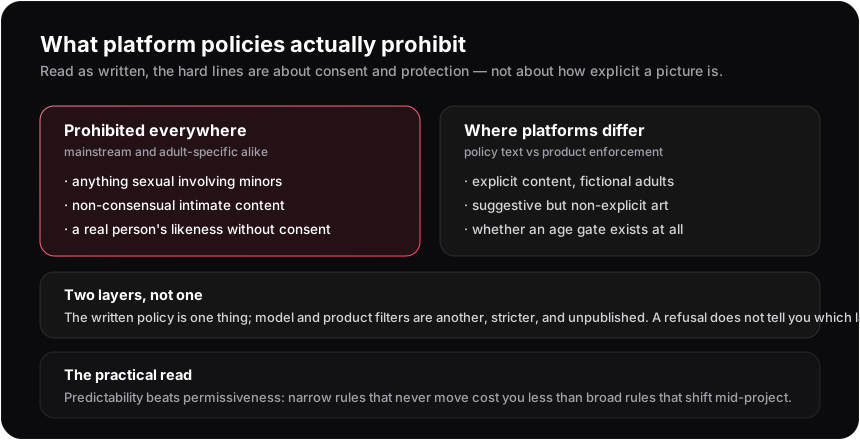 The hard lines are consent and protection; the variable part is fictional adult content.
What the official documentation confirms
OpenAI's current Moderations API reference defines sexual as content meant to arouse sexual excitement and separately defines sexual/minors for sexual content involving someone under 18. The same reference says text and image inputs can be classified for harmful content. That is the primary source we can cite.
What it does not provide is a stable list of consumer ChatGPT image prompts that will pass or fail. An API classification category is not the same thing as a published product guarantee. Checked 24 August 2026.
Why you still get refused
Because published policy, moderation classification and consumer-product enforcement are different layers. A blocked prompt tells you the request was not accepted at that moment; it does not reveal a reusable threshold. We did not attempt to bypass any safeguard, and this article contains no techniques for doing so. If the workflow depends on a category a general-purpose tool does not reliably support, choose a tool whose public acceptable-use policy covers the intended fictional-adult use case.
| Request | Mainstream general-purpose tools | Purpose-built adult tools |
|---|---|---|
| Anything sexual involving minors | Never an acceptable test | Prohibited |
| Real identifiable person in intimate context | Not a safe or supported assumption | Prohibited on any responsible service |
| Someone's likeness without consent | Not a safe or supported assumption | Prohibited on any responsible service |
| Explicit content, fictional adult character | No published generation guarantee | The intended use case |
| Suggestive but non-explicit art | Product behaviour can change | Permitted |
| Published fit for adult art | No | Required by design |
Who this article is for
Useful to you if you have been getting refusals and want to know whether you are breaking a rule or hitting a filter, or if you are deciding whether a general-purpose tool can cover an adult project at all.
Not useful if you want workarounds. There are none here, and the categories that are actually prohibited — minors, real people without consent — are prohibited everywhere that matters, including on our own service.
What this means if you are choosing a tool
Three practical consequences:
- Stop testing a general-purpose model for adult work. Refusals there are a product decision, not a bug you can prompt around, and they change without notice.
- Check what a purpose-built tool prohibits, not just what it allows. A service with no stated rules about real people or minors is a liability to its users, not a permissive paradise. Ours prohibits both explicitly.
- Check the privacy posture at the same time. Adult generation and data retention are the same decision in practice: default visibility and how long files are kept matter more than any feature list.
The same policy pattern shows up across the mainstream tools. Midjourney's version is covered in can you make NSFW on Midjourney, and xAI's is in Grok's image rules — where the prohibitions are phrased even more explicitly around real people.
Use a tool built for it
Fictional characters only, real people and minors prohibited — and no refusal roulette.
Open the generatorWhat we did and did not verify
We read the current official Moderations reference and describe only what it establishes. We did not attempt prohibited content, did not test refusal behaviour and do not describe hidden enforcement thresholds. If the official documentation changes, the checked date makes this audit falsifiable. Our own testing standards are in how we test.
Frequently asked questions
Do not rely on ChatGPT for an explicit adult-art workflow. OpenAI documents sexual-content moderation categories but does not publish a stable consumer image prompt matrix or a guarantee of explicit generation.
The Moderations API reference defines sexual and sexual/minors as separate harmful-content categories and supports text and image classification. It is not a complete list of consumer ChatGPT image outcomes.
No. A refusal is a product outcome at that moment; it does not reveal a stable moderation threshold or prove that every nearby request has the same status.
Anything sexual involving minors, non-consensual intimate imagery, and real people's likenesses used without consent. Any service that does not state these rules is a warning sign about that service.
This article does not cover any, deliberately. Filters are a product decision rather than a bug, they change without notice, and the categories that are genuinely prohibited are prohibited on purpose-built tools too.
A service designed for it, with an age gate, explicit rules against real people and minors, and a stated retention policy. Check the rules and the privacy posture before generating anything.