A generation comes back wrong and the reflex is to rewrite the prompt. Usually the prompt is not the problem. Bad generations have four possible culprits — the reference, the style, the pose description and the prompt text — and each one produces a recognisable signature. Read the symptom first, and you can change the one input that matters instead of shuffling words and re-rolling.
Start from the symptom
Three symptoms cover almost everything, and they do not overlap. Identify which one you have before touching any input.
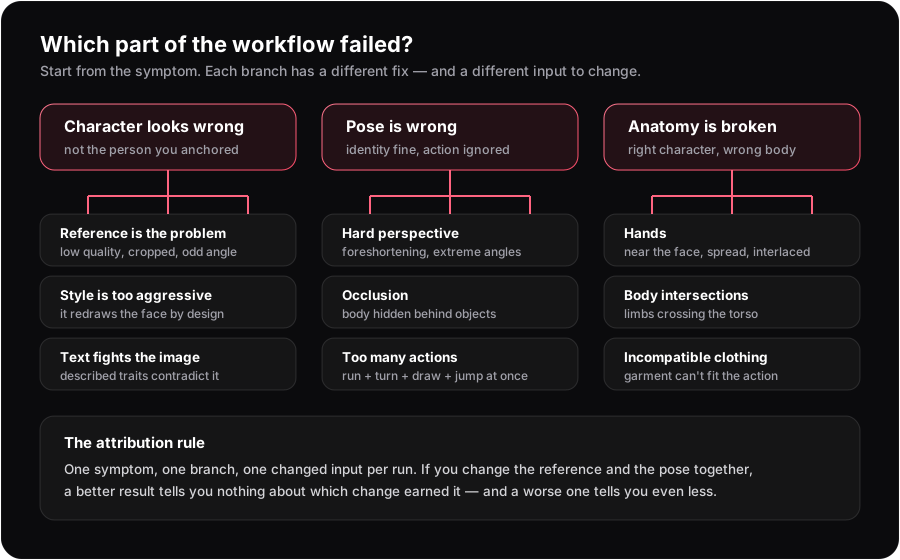 Symptom first, then the branch, then one changed input.
Symptom 1: the character looks wrong
The pose is fine, the scene is fine, the person is not who you anchored. Three causes, in the order worth checking:
- The reference is the problem. Low resolution, a heavy crop, an extreme angle, or a face partly hidden. A reference that does not show the face cleanly cannot anchor it. Fix the input, not the prompt.
- The style is too aggressive. Some styles redraw faces by construction — anime and semi-realistic do not share a face grammar, so a style change is always a new face drawn to resemble the old one. If identity matters more than look, choose the style once and keep it.
- Your text contradicts the image. Describing hair colour, age or build that differs from the reference sets up a fight your reference may lose. Describe the scene; let the reference carry the person. The mechanics of that conflict are in the piece on identity drift, and the cost of over-describing is in why longer prompts produce worse images.
A quick discriminator: swap the style to something neutral and re-run. If identity snaps back, the style was your culprit. If it does not, look at the reference.
Symptom 2: the pose is wrong
Identity holds, the action does not happen. This branch is the one people misdiagnose most, because they assume a wrong pose means an unclear description. Usually it means an expensive description.
- Hard perspective. Extreme angles and foreshortening get flattened. In the run above, "extreme low angle, one arm reaching toward the viewer, heavily foreshortened" produced the low angle but quietly declined the foreshortening, and the reaching hand came back deformed. Models regress toward the poses they have seen most.
- Occlusion. "Seen through a narrow doorway, the left half of her body hidden behind the door frame" produced no doorway at all and no occlusion — just a clean, well-lit standing figure. The image is good. The brief was ignored.
- Too many actions. "Running while looking back over her shoulder, drawing a sword, cloak flying, jumping over a crate" produced one action: a raised sword. Four verbs compete, one wins. Overloaded poses fail by simplification.
The fix for all three is the same shape: ask for less, then add back. One action per generation, moderate angles, and if you need occlusion, describe the occluding object as part of the scene rather than as a constraint on the body.
Symptom 3: the anatomy is broken
The character is right, the pose is roughly right, the body is not.
- Hands. The most reliable failure in AI art, and it compounds near the face: "both hands raised in front of the face, fingers spread wide, interlacing her fingers" produced exactly the mess you would predict — merged fingers, an indeterminate count, digits crossing the face. Two high-difficulty regions in one composition multiply rather than add. Keep hands away from the face, and prefer hands that are relaxed, partially hidden, or holding something simple. The frame below is what that brief produced.
- Body intersections. Limbs crossing the torso, arms behind the back, legs crossed at an odd angle. Each intersection is a place where the model has to decide what is in front of what.
- Incompatible clothing. A garment that cannot physically do the action — a fitted floor-length dress in a running pose, plate armour in a curled-up pose. The model resolves the contradiction by breaking one of them, usually the body.
A standing negative prompt helps with recurring anatomy artifacts, but it cannot fix a composition that is asking for something impossible. Negative prompts remove; they do not reconcile.
The failure that looks like success
The dropped-occlusion frame deserves its own warning, because it is the failure mode that wastes the most time. It is not ugly. Nothing looks broken. If you were skimming a batch, you would keep it — and only later notice the scene you actually asked for never appeared.
This is why "did I like the image" is the wrong review question. The right one is "did I get what I asked for", checked against the brief, one clause at a time. Beautiful non-compliance is still non-compliance, and if you count it as a success you will never learn which of your instructions this model quietly ignores.
The attribution rule
Everything above collapses without one discipline: one changed input per run.
How to isolate a failing input
- 1
Reproduce the failure once
Same inputs, fixed seed. If it does not reproduce, you had bad luck rather than a bad input — re-roll and move on.
- 2
Name the symptom
Character, pose or anatomy. Write it down; this decides which branch you are in and stops you from changing three things at once.
- 3
Change the single most likely input
Reference for character problems, pose wording for pose problems, composition for anatomy problems. Keep every other field byte-identical.
- 4
Compare against the reproduced failure, not against your best result
The question is whether this edit helped, not whether this is the best image you have made.
- 5
If two edits are needed, do them in two runs
Two simultaneous edits give you an outcome with no attribution. That is not a diagnosis, it is a re-roll with extra steps.
Once you know which input is at fault, the cost of a fix drops sharply — and so does the number of attempts you spend, which is the thing you are actually paying for. That arithmetic is in cost per keeper.
Frequently asked questions
Identify the symptom first. A wrong character usually means the reference or the style; a wrong pose usually means the pose description is too hard or overloaded; broken anatomy usually means hands, body intersections or clothing that cannot do the action.
Because some requests are harder than others. Occlusion and extreme foreshortening get dropped rather than attempted, and a pose with four actions typically resolves to one. The output can still look good, which makes it easy to miss.
Keep hands away from the face, avoid spread or interlaced fingers, and give them something simple to hold or partially hide them. Add recurring artifacts to a standing negative prompt, but do not expect it to rescue an impossible composition.
Depends on the symptom. Character problems point at the reference or the style; pose and anatomy problems point at the description. Change one input per run so you can attribute the result.
That is beautiful non-compliance, the most easily missed failure. Review against the brief clause by clause rather than asking whether you like the picture.
Yes. A fixed seed lets you reproduce a failure and confirm that a change caused an improvement, instead of mistaking random variation for progress.