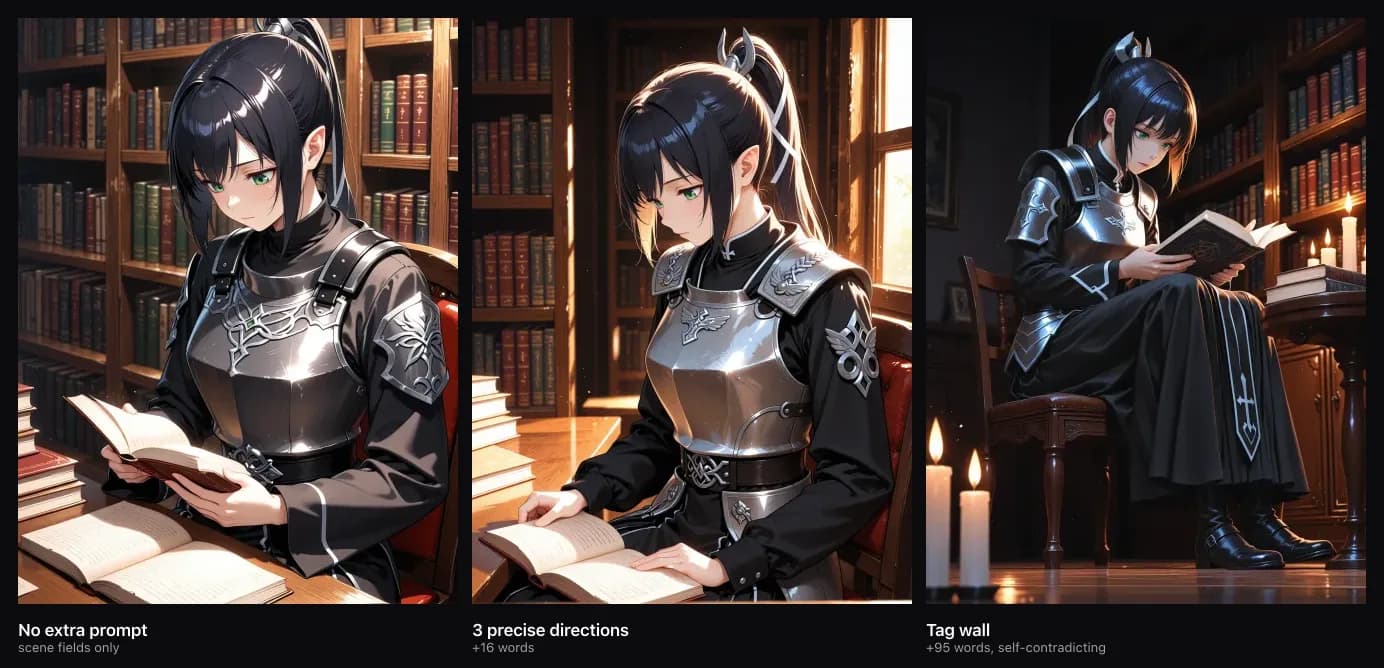
The instinct with a disappointing generation is to add words. Then more words. Then a wall of tags harvested from other people's prompts. It feels like turning up the precision, and it usually does the opposite: past roughly twenty well-chosen words, extra text competes with itself, spreads the model's attention, and quietly rewrites the parts of the image you were happy with. This is prompt dilution, and it is easy to demonstrate.
The test: one seed, three prompt lengths
Same character reference, same scene fields (sitting at a table reading in an old library), same style, same fixed seed. The only variable is how much free text I added on top.
- No extra prompt. A clean, close frame: the character at a table, an open book, warm shelves behind her. Perfectly usable.
- Plus sixteen precise words — "warm afternoon light from a tall window on the left, three-quarter view, shallow depth of field". The best frame of the three. The window arrived, the light warmed, the angle turned, the background softened. One of the three directions landed imprecisely (the window ended up on the wrong side), which is a fair hit rate for something that improved every other aspect.
- Plus ninety-five words of tags. The subject retreated into the middle distance, the face shrank to a few dozen pixels, the warm afternoon became a dark room lit by candles, and the reading-at-a-table composition dissolved into a figure perched on a chair. Nothing in the brief asked for any of that.
The third prompt did not fail because tags are forbidden. It failed
because it asked for opposites: extreme close-up portrait next to
full body shot, golden hour next to moonlight next to
candlelight, detailed background next to minimalist empty background, shallow depth of field next to deep depth of field. Given
mutually exclusive instructions, a model does not pick one. It blends,
and a blend of a close-up and a full body shot is a mid-distance shot
nobody asked for.
Note also what the fixed seed did not do: it did not protect the composition. A seed makes runs comparable when the prompt is stable; it cannot hold a layout together while the text underneath it changes.
The five mechanisms
Competing attributes
Any two instructions that cannot both be true resolve to a compromise. This is the big one, and it hides inside vocabulary that sounds complementary: "cinematic" and "flat illustration", "intimate framing" and "epic composition". If two tags come from different visual traditions, they are competing even when neither is literally the opposite of the other.
Repetition that does not amplify
"Detailed, highly detailed, ultra detailed, intricate details" reads like emphasis and behaves like clutter. Repeating a concept does not multiply its weight; it consumes room that a different, actually informative word could have used. If you want emphasis, be specific about what is detailed — "detailed engraving on the breastplate" does real work.
Incompatible styles
Style words are the most destructive to stack, because each one implies a whole rendering grammar: line weight, shading, palette, edge treatment. "Oil painting texture, watercolour wash, photorealistic skin, flat anime cel shading" is four grammars in one sentence, and the output will belong to none of them. Pick one style and let the other fields carry the variation.
Too many actions
A pose with four verbs resolves to one. We tested that separately: "running while looking back over her shoulder, drawing a sword, cloak flying, jumping over a crate" produced a raised sword and nothing else. Actions do not blend the way lighting does — they compete winner-take-all, and you do not get to choose the winner. Details are in the diagnostic guide.
Dilution proper
Even with zero contradictions, a longer prompt spreads attention thinner. Every token you add reduces the relative weight of the tokens that mattered most — the subject and the two or three things you actually cared about. This is why the same instruction can work in a short prompt and vanish in a long one.
The quality-tag myth
masterpiece, best quality, 8k, award winning, trending on artstation. These are the most-copied tokens in AI art and among the least
useful in a modern pipeline. Our tag wall contained all of them, and it
produced the least detailed subject of the three frames — not because they
actively harm, but because they occupy the prompt while saying nothing
about your image. "8k" is not a description of anything the model can place
in the frame.
If you want a sharper result, the levers that work are the boring ones: better framing, a simpler pose, one style, a negative prompt for the artifacts you keep seeing, and a batch to pick from.
What to write instead
How to write a prompt that survives contact with the model
- 1
Let the reference carry identity
Everything you would have described about the face, hair and build is already in the image. Words spent on identity are words competing with your reference.
- 2
Name the subject action once
One verb. 'Reading a book' or 'looking over her shoulder', not both. If you need a second action, that is a second generation.
- 3
Add two or three precise directions
Light, camera angle, depth. 'Warm light from a tall window, three-quarter view, shallow depth of field' is sixteen words that each change something visible.
- 4
Choose exactly one style
Style is a grammar, not a flavour. Two styles produce a third thing that belongs to neither.
- 5
Stop, generate, then add one thing
Prompting is iterative, but iteration means one change per run. Adding five phrases at once gives you an outcome you cannot attribute to any of them.
- 6
Move recurring complaints into the negative prompt
Things you never want belong in a standing negative list, not repeated in every positive prompt where they compete for attention.
When a long prompt is actually right
Length is not the villain; contradiction and redundancy are. Long prompts earn their keep when every clause is doing distinct, non-conflicting work — a complex environment with several named objects, or a multi-element composition where you genuinely need to place five things.
The test is mechanical: read your prompt and count the clauses that change something visible in the frame. If forty tags produce twelve real instructions and twenty-eight decorations, delete the twenty-eight. If a long prompt survives that audit, keep it.
| Prompt | Typical result | Use when |
|---|---|---|
| Scene fields only | Clean, conventional framing; sometimes generic | You want a solid baseline fast |
| Fields + 2–4 precise directions | Best control per word; most edits land | Almost always — this is the sweet spot |
| Fields + a paragraph of distinct detail | Works if nothing conflicts; slower to converge | Complex scenes with several placed objects |
| A wall of copied tags | Averaged composition, lost subject, unpredictable light | Never, in our testing |
Frequently asked questions
For a reference-based workflow, the scene fields plus two to four precise directions — roughly 15 to 30 words of free text. That range gave the best result in our test, better than both no extra prompt and a 95-word tag wall.
Three reasons: contradictory instructions get averaged rather than chosen between, repeated words consume attention without adding information, and every extra token reduces the relative weight of the ones that mattered.
They do not describe anything the model can place in the frame, so they mostly occupy space. Our tag wall included all of them and produced the least detailed subject of the three test frames.
The effect where adding more text weakens the instructions you care about, because the model's attention is spread across everything you wrote. The same phrase can work in a short prompt and be ignored in a long one.
Rarely successfully. Each style implies a full rendering grammar — line weight, shading, palette — and combining two produces an output belonging to neither. Choose one style and vary other fields instead.
Iterate, one change per run. A single long prompt gives you a result you cannot attribute to any specific clause, which means you learn nothing from it even when it works.