The short answer
Grok has an NSFW setting, but xAI's own documentation says enabling it does not disable moderation. Sexual content involving minors and non-consensual intimate imagery remain prohibited regardless of settings; the acceptable-use policy also bans undressing or nudifying real people, sexualising a real person's likeness and pornographic depictions of identifiable people.
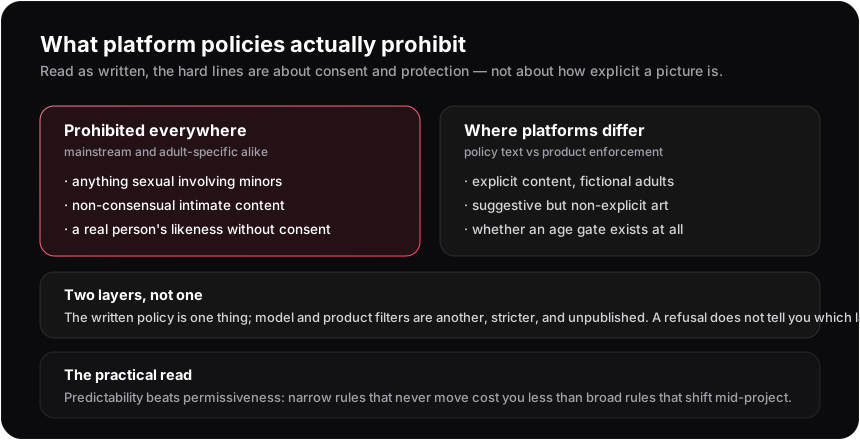 The hard lines are consent and protection; the variable part is fictional adult content.
What the policy prohibits, in its own terms
Reading the current published version, the image-relevant prohibitions are:
- Undressing or nudifying real persons, or otherwise altering a real person's image to depict them in an intimate or sexual context.
- Depicting likenesses of persons in a pornographic manner.
- Defamation and false light — portraying a person in a way that misrepresents them.
- Sexualising or exploiting children, with a stated reporting obligation.
These points come directly from xAI's Acceptable Use Policy. The consumer Grok image FAQ adds the product-level boundary: the NSFW setting does not disable safety protections, specific moderation rules are not published, and repeated prohibited attempts can lead to account suspension. Checked 24 August 2026.
Notice how much of that is about identifiable humans. The policy is written against a specific abuse pattern — taking a real person's photo and sexualising it — which is exactly the harm that made "nudify" apps notorious, and exactly what a responsible adult-art service must also prohibit. Ours does.
Who this article is for
Useful if you were trying to work out whether Grok is a viable tool for adult creative work, or whether a refusal you hit was a rule or a filter.
Not useful if you want to get around anything. Real-person sexual imagery is not a grey area to be argued with — it is prohibited on xAI, on OpenAI, on Midjourney, and on us.
The thing nobody warns you about: churn
Platform policies in this space change often, and the phrasing of the version we read even notes it is one of several. For a one-off image that does not matter. For a project — a series, a character, a set you plan to finish over weeks — it matters a lot:
- Enforcement thresholds move without an announcement.
- A model update can start refusing prompts that worked last month.
- Access can be restricted after repeated prohibited attempts, according to xAI's product FAQ.
That is the argument for using a tool whose entire purpose is the thing you are doing, rather than one where your use case sits at the edge of what is tolerated. It is not about permissiveness; it is about predictability.
| Question | Why it matters |
|---|---|
| Does it prohibit real-person likeness explicitly? | This is the single most important line. A service without it is a risk to you and to others. |
| Does it prohibit anything involving minors, with reporting? | Non-negotiable. Its absence tells you the service has not thought seriously about anything. |
| Does it say what happens to your generated files? | Retention is usually a separate document, and usually vaguer than the content rules. |
| How often has the policy changed? | Churn is the practical risk to any multi-week project. |
The last two are the ones people skip, and they are the ones that decide what happens to your work if a platform changes its mind.
Where that leaves adult art
For fictional-adult work, the accurate answer is narrower than either “anything goes” or “Grok bans NSFW.” The product exposes an NSFW setting, while the official FAQ says moderation remains active and some categories can never be enabled. xAI does not publish the detailed threshold, so we cannot promise which borderline prompts will work. A purpose-built service offers a different trade: a public acceptable-use policy written around fictional-adult art while keeping real people and minors outside the product boundary.
What we can honestly tell you about ourselves is on the product fact page, with a verification date and a list of what the tool cannot do.
Predictable rules beat permissive ones
Fictional characters, stated limits, no refusal roulette.
Open the generatorWhat we verified
We read xAI's current acceptable-use policy and its consumer image FAQ. We did not test Grok's image generation, did not attempt prohibited prompts and make no claims about unpublished enforcement thresholds. Policies change; the checked date is there so you can tell how stale this is. Our standards for this kind of article are in how we test.
Frequently asked questions
Grok exposes an NSFW setting, but xAI says it does not disable moderation. Sexual content involving minors and non-consensual intimate imagery remain prohibited, and detailed moderation thresholds are not published.
Undressing or nudifying real persons, altering a real person's image into an intimate or sexual context, depicting likenesses pornographically, portraying people in a false light, and sexualising or exploiting children.
Not in an intimate or sexual context. This prohibition is consistent across xAI, OpenAI, Midjourney and purpose-built adult services including ours.
xAI says its safety systems are updated continuously. For a multi-week creative project, unpublished threshold changes are a practical risk even when the public policy stays readable.
In one direction only. It permits fictional adult content, and it should be at least as strict as mainstream platforms about real people and minors. If it is not, that is a reason to avoid it.
No. We read the published policy and report what it says with its date. We did not attempt prohibited prompts and do not describe enforcement we cannot observe.